There are countless images of Lord Shiva across India.
Some show him sitting in deep meditation on Mount Kailash. Some portray him dancing the cosmic Tandava. Some show him with the crescent moon resting on his head, the Ganga flowing from his matted hair, and a serpent coiled around his neck.
But perhaps one of the most powerful images is also one of the strangest:
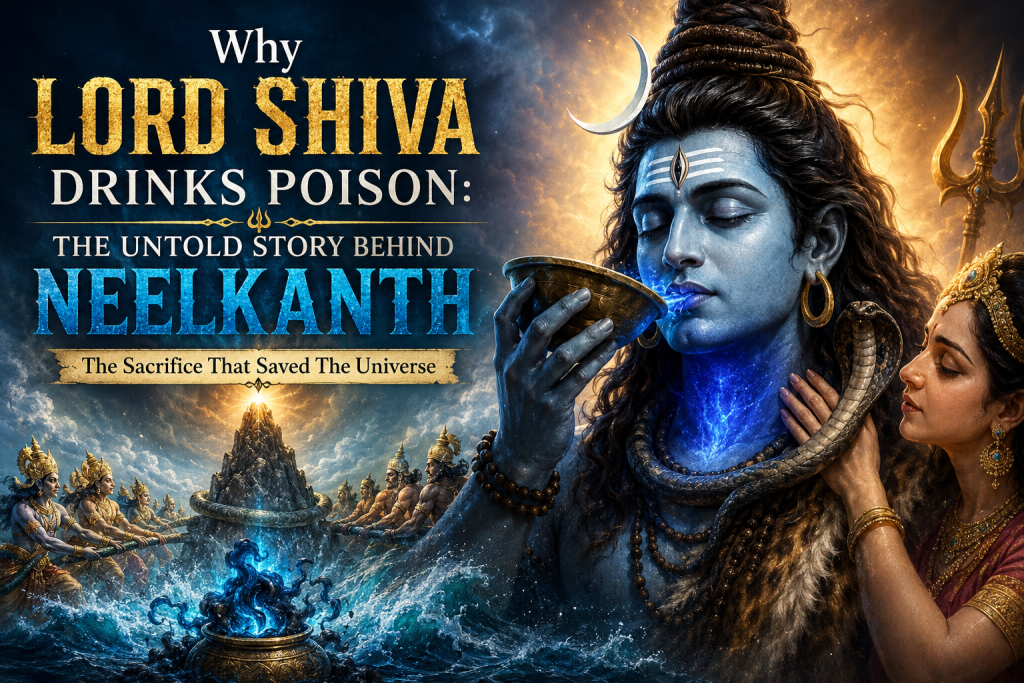
Lord Shiva holding deadly poison in his throat.
His throat turns blue.
His body remains calm.
The gods are saved.
The universe survives.
And Shiva becomes known as Neelkanth — the Blue-Throated One.
But why did Shiva drink a poison powerful enough to destroy creation?
Was it simply an act of sacrifice?
Or is there a deeper story hidden inside this ancient legend?
The answer takes us back to one of the greatest episodes in Hindu mythology — Samudra Manthan, the Churning of the Cosmic Ocean.
And surprisingly, the most important part of that story may not be the nectar of immortality.
It may be the poison that appeared before the nectar.
The Ocean That Contained Everything
Long before the gods and demons fought over the nectar of immortality, there was a great problem in the celestial world.
According to the traditional account found in the Puranic literature, the Devas had lost their strength.
The universe depended upon a delicate balance between different cosmic forces, but the gods were no longer powerful enough to maintain their position.
Lord Vishnu advised them that they would need the help of their rivals — the Asuras.
The solution was extraordinary.
They would churn the Kshira Sagara, the cosmic ocean of milk.
Hidden within this vast ocean were said to be extraordinary treasures, including Amrita, the nectar of immortality.
But extracting it would not be easy.
The gods and Asuras needed a gigantic churning rod.
For this, they chose Mount Mandara.
Then they needed a rope capable of wrapping around the mountain.
That rope was Vasuki, the great serpent.
The mountain was placed into the cosmic ocean, Vasuki was wrapped around it, and the Devas and Asuras began pulling from opposite sides.
The churning began.
The ocean began to move.
And from its depths, extraordinary things started emerging.
Treasures appeared.
Divine beings appeared.
Celestial objects appeared.
But before the nectar could emerge, something far more terrifying came out of the ocean.
Something nobody had expected.
Something so dangerous that even the gods were afraid.
It was Halahala.
The Poison More Dangerous Than Death
Halahala is described in traditional accounts as a terrible, destructive poison.
Its power was not limited to killing an individual.
Its emergence threatened the entire creation.
The atmosphere itself became dangerous.
The gods became frightened.
The Asuras were frightened.
Everyone who had participated in the churning suddenly realized the same thing:
They had awakened something they could not control.
The irony is striking.
Everyone wanted the nectar.
Nobody wanted the poison.
Yet the poison came first.
The Devas and Asuras had started the churning because they wanted something valuable.
But the first result was something deadly.
This is one of the most fascinating aspects of the mythology.
The cosmic ocean was not simply a treasure chest.
It contained everything.
The beautiful and the terrible.
The life-giving and the destructive.
The nectar and the poison.
And when the ocean was disturbed, both emerged.
The gods could not defeat Halahala.
They could not contain it.
They could not simply throw it away.
If released into the world, it could destroy creation.
So the gods turned toward the one being who was capable of dealing with something that nobody else could handle.
Lord Shiva.
Why Did They Go to Shiva?
This is where the story becomes deeper than a simple tale of divine rescue.
Shiva occupies a unique position in Hindu mythology.
He is not merely a god who grants wishes.
He is often portrayed as the one who exists beyond conventional opposites.
Creation and destruction.
Life and death.
Beauty and terror.
Attachment and detachment.
He lives in the cremation ground yet is regarded as a compassionate deity.
He wears ashes yet is worshipped with flowers.
He carries a trident yet is called Ashutosh, the easily pleased one.
He is simultaneously terrifying and deeply compassionate.
So when Halahala appeared, the gods approached Shiva.
They sought his help.
And Shiva agreed.
But then came the most extraordinary moment.
Shiva drank the poison.
Why Would Shiva Drink Poison?
At first glance, the answer seems simple:
Shiva wanted to save the universe.
But mythology often works on multiple levels.
The story can be understood literally as a divine act of protection.
But symbolically, it contains another powerful message.
The poison represented something that could not simply be destroyed.
It had to be contained.
And Shiva became that container.
He did not drink Halahala because he wanted it.
He drank it because somebody had to prevent it from spreading.
This distinction is important.
Shiva did not consume the poison for pleasure.
He accepted something terrible so that others would not have to suffer from it.
That is why the story is often interpreted as one of the greatest examples of self-sacrifice and compassion in Hindu mythology.
The Moment Shiva Became Neelkanth
According to the traditional story, Shiva took the Halahala poison and held it in his throat.
But another extraordinary event occurred.
If the poison entered his entire body, it could potentially cause destruction.
So Shiva kept it confined to his throat.
His throat turned blue.
And from this event came one of his most famous names:
Neelkanth — the One with the Blue Throat.
“Neel” means blue.
“Kanth” refers to the throat.
The image of Neelkanth therefore carries the memory of the moment when Shiva contained cosmic poison.
But there is something fascinating here.
Shiva did not allow the poison to enter his body completely.
He did not spit it out into creation either.
He held it between the two possibilities.
He contained destruction without becoming destruction.
That is perhaps the deeper meaning hidden behind the blue throat.
The Role of Maa Parvati
There is another important part of the story that is sometimes overshadowed by Shiva’s act.
It involves Maa Parvati.
Different traditional versions and regional retellings describe the episode with variations, but a popular interpretation says that Parvati intervened to prevent the poison from spreading through Shiva’s body.
She held or restricted his throat, ensuring that the poison remained there.
This created the image of Shiva carrying the poison in his throat without allowing it to destroy him.
The symbolism is beautiful.
Shiva represents the power to absorb and contain.
Parvati represents the power of Shakti — the divine energy that accompanies and balances him.
The story therefore isn’t simply about Shiva acting alone.
It also reflects the relationship between Shiva and Shakti.
Without Shakti, Shiva is incomplete.
And without Shiva, Shakti’s cosmic role cannot be understood in isolation.
Why Didn’t Shiva Simply Destroy the Poison?
This is one of the most interesting questions to ask.
If Shiva is the destroyer, why didn’t he simply destroy Halahala?
Because the story is not really about destroying every problem.
Some problems cannot be eliminated immediately.
They must first be contained.
Think about what poison does.
Once released, it spreads.
The longer it remains uncontrolled, the greater the damage.
Halahala therefore becomes a powerful metaphor for destructive forces.
Anger can spread.
Hatred can spread.
Fear can spread.
Jealousy can spread.
Violence can spread.
Rumours can spread.
One person’s bitterness can affect an entire family.
One person’s hatred can affect an entire community.
One person’s uncontrolled anger can destroy years of relationships.
The mythology gives us an ancient image of this principle:
When something toxic appears, the first responsibility is to prevent it from spreading.
That is exactly what Shiva does with Halahala.
The Hidden Lesson: Shiva Did Not Swallow the Poison Completely
There is a subtle distinction in the symbolism.
Shiva did not allow the poison to become part of his entire being.
He held it at the throat.
This can be interpreted as a lesson in emotional discipline.
Life inevitably gives us unpleasant experiences.
People hurt us.
Circumstances disappoint us.
We experience betrayal, failure, anger, loss and injustice.
We cannot prevent every negative experience from entering our lives.
But there is a difference between experiencing negativity and becoming negative.
Shiva’s blue throat can therefore be seen as a metaphor:
You may encounter poison without allowing the poison to become you.
You can experience anger without becoming an angry person.
You can experience betrayal without becoming incapable of trust.
You can experience failure without deciding that you are a failure.
You can experience hatred without becoming hateful.
The poison can touch you.
But it does not have to define you.
That is the deeper meaning many modern readers can take from the Neelkanth story.
The Gods Wanted Nectar — Shiva Accepted Poison
There is another powerful contrast hidden inside Samudra Manthan.
The Devas and Asuras were searching for Amrita.
Everyone wanted immortality.
Everyone wanted the reward.
But when Halahala emerged, nobody wanted responsibility for it.
This contrast makes Shiva’s role extraordinary.
While others were fighting over what was valuable, Shiva accepted what was dangerous.
The gods wanted the nectar.
Shiva took the poison.
This gives the story a powerful moral dimension.
In ordinary life, people naturally want rewards.
We want success.
We want recognition.
We want wealth.
We want happiness.
We want respect.
But every society also requires people willing to deal with difficult responsibilities.
Someone must solve the crisis.
Someone must protect others.
Someone must take responsibility when things go wrong.
Someone must stand between danger and the vulnerable.
In the mythology, Shiva becomes that figure.
Why Is Shiva Associated With Poison?
Shiva’s connection with poison does not end with Halahala.
His imagery itself contains elements that would normally frighten people.
A serpent rests around his neck.
He wears ashes.
He resides in the mountains and cremation grounds.
He is associated with destruction.
Yet devotees approach him with immense love.
This contradiction is central to understanding Shiva.
He does not represent only the pleasant side of existence.
He represents the acceptance of reality in its entirety.
Death exists.
Suffering exists.
Destruction exists.
Fear exists.
But none of these things are outside the cosmic order.
Shiva stands at the boundary between what humans fear and what they must eventually accept.
That is why the image of Neelkanth fits Shiva so perfectly.
He is the deity who can hold something terrifying without being consumed by it.
The Blue Throat and the Power of Transformation
There is another way to interpret the story.
The poison does not disappear.
It remains.
But its destructive potential is controlled.
This is important because transformation does not always mean eliminating something.
Sometimes transformation means changing our relationship with it.
A painful experience may remain in our memory.
But its meaning can change.
A failure may become a lesson.
A loss may create wisdom.
A difficult experience may make someone more compassionate.
A mistake may become the foundation for better decisions.
The event remains part of the story, but it no longer controls the future.
In this sense, Shiva’s blue throat represents a remarkable psychological idea:
Pain can exist without becoming your identity.
Why Is the Poison Called Halahala?
The term Halahala is associated with the deadly poison emerging during the churning of the cosmic ocean.
Different scriptures and traditions sometimes present the details differently, and mythology has been preserved through numerous Puranic texts, regional traditions and oral retellings.
This is important because Hindu mythology is not always a single linear narrative.
Stories can have variations.
Names, sequences and details may differ between texts and regional traditions.
But the central idea remains remarkably consistent:
A deadly poison emerges during Samudra Manthan, threatening creation, and Shiva takes it upon himself to save the universe.
That central image has survived for centuries.
The Forgotten First Product of the Churning
People usually remember Samudra Manthan for one thing:
Amrita.
The nectar of immortality.
But Halahala came before the nectar.
That detail gives the entire story a different meaning.
Before the reward came the crisis.
Before immortality came poison.
Before the treasures appeared, something terrible had to be confronted.
This pattern appears repeatedly in mythology and in human life.
A new beginning can emerge from chaos.
A transformation can begin with discomfort.
A difficult journey can expose problems that were hidden beneath the surface.
The cosmic ocean therefore becomes more than a mythological ocean.
It can be seen as a metaphor for the human mind and existence itself.
When we churn deeply enough, we may discover both nectar and poison.
What Does Samudra Manthan Represent Within Us?
Imagine the cosmic ocean as your own mind.
The gods and Asuras can represent conflicting forces within human nature.
One side wants discipline.
Another wants desire.
One side wants wisdom.
Another wants immediate pleasure.
One side wants peace.
Another wants revenge.
When life begins to “churn” us — through challenges, ambition, relationships, failures or major changes — things hidden inside us begin to surface.
Sometimes we discover extraordinary qualities.
Courage.
Creativity.
Compassion.
Wisdom.
Strength.
But we may also discover our own Halahala.
Anger.
Fear.
Jealousy.
Insecurity.
Ego.
Resentment.
The mythology suggests that discovering these things is not necessarily the end.
The real question is:
What will you do with your poison?
Will you spread it?
Will you allow it to consume you?
Or will you learn to contain it?
That is where Shiva’s lesson becomes surprisingly relevant.
Neelkanth: The Symbol of Controlled Power
Shiva is powerful enough to destroy.
Yet in the Halahala episode, his greatest power is not destruction.
It is restraint.
That is a profound distinction.
Anyone can react.
Real strength lies in knowing when not to react.
Anyone can return anger with anger.
Strength lies in stopping the cycle.
Anyone can spread pain after being hurt.
Wisdom lies in refusing to pass that pain to someone else.
Shiva’s blue throat can therefore symbolize controlled power.
He has the ability to destroy the poison.
But instead, he contains it.
His strength is expressed through restraint.
Why Devotees Remember Neelkanth During Sawan
The month of Sawan, traditionally associated with Lord Shiva, has a special place in Shaiva devotional traditions.
Devotees visit Shiva temples, offer water and perform various forms of worship.
The association between Shiva and water is especially meaningful in devotional practice.
The Neelkanth story adds another layer to this relationship.
The deity who once held cosmic poison in his throat is remembered through prayers, offerings and rituals during this sacred period.
In many traditions, devotees offer Ganga water, milk, bel leaves and other customary offerings to Shiva.
The rituals vary by region and tradition, but the underlying devotion is often connected with seeking Shiva’s blessings, protection and inner purification.
The image of Neelkanth becomes particularly powerful during Sawan because devotees are reminded of the deity who accepted suffering for the protection of creation.
The Most Powerful Part of the Story Isn’t the Poison
It is easy to focus on the supernatural element.
A cosmic ocean.
A deadly poison.
A blue throat.
Gods and Asuras.
But perhaps the greatest lesson is simpler.
Someone had to take responsibility.
The gods had participated in the churning.
The Asuras had participated.
Everyone wanted the reward.
But when disaster appeared, Shiva did not ask:
“Who caused this?”
He did not ask:
“What’s in it for me?”
He simply acted.
This is what makes the story timeless.
Leadership is not always about receiving the greatest reward.
Sometimes leadership means standing in front of the greatest danger.
Shiva’s Poison Is Not a Story About Suffering — It Is About Purpose
There is an important distinction here.
The story should not be interpreted as saying that people should endlessly tolerate suffering or accept everything harmful.
Shiva’s action was purposeful.
He contained the poison because doing so protected creation.
That is very different from allowing someone to repeatedly harm you.
The deeper lesson is not:
“Accept every poison that people give you.”
It is:
“Do not allow poison to spread through you.”
There is wisdom in knowing what to absorb, what to transform, what to contain and what must be stopped.
This makes the Neelkanth story surprisingly relevant to modern emotional life.
What If Neelkanth Were a Message for Us?
Imagine someone insults you.
That insult is the poison.
You cannot control what another person says.
But you can decide whether you will carry it into every relationship afterward.
Someone betrays you.
The betrayal is the poison.
You cannot erase the event.
But you can decide whether you will become a person who betrays everyone because one person betrayed you.
You experience failure.
The failure hurts.
But you can choose whether it becomes wisdom or bitterness.
This is the Neelkanth principle:
Hold the poison without becoming poisonous.
Perhaps that is why this ancient story continues to resonate.
The Blue Throat as a Reminder of Sacrifice
Shiva’s blue throat is not presented as a badge of victory in the conventional sense.
It is a mark left by sacrifice.
The blue colour reminds the world of what Shiva accepted.
He carried a burden that nobody else could carry.
And that is why Neelkanth is not merely another name for Shiva.
It is a reminder of a particular quality:
Compassion powerful enough to accept responsibility.
The Deeper Mystery of Samudra Manthan
The churning of the cosmic ocean can ultimately be understood as a story about transformation.
The ocean contains treasures.
But it also contains danger.
The churning brings everything to the surface.
That is how transformation works.
When life remains undisturbed, many things remain hidden.
But when we challenge ourselves, grow, change careers, build relationships, pursue ambitions or face crises, hidden parts of ourselves emerge.
Some are beautiful.
Some are painful.
Some frighten us.
The lesson of Samudra Manthan is not to stop churning.
It is to become capable of dealing with whatever the churning reveals.
And Shiva shows us how to deal with the most dangerous part.
Neelkanth: The God Who Held the World’s Poison
Perhaps the most beautiful way to understand this story is to forget, for a moment, the grandeur of the cosmic setting.
Forget the mountain.
Forget the serpent.
Forget the ocean.
Forget the gods and Asuras.
Imagine simply this:
The world is in danger.
Everyone is afraid.
Nobody knows what to do.
Then Shiva steps forward.
He takes the poison.
He holds it.
His throat turns blue.
And the world survives.
That is the essence of Neelkanth.
Not power for domination.
Not power for personal gain.
But power used to protect.
Final Reflection: What Will You Do With Your Halahala?
Every human being encounters some form of Halahala.
It may arrive as disappointment.
It may arrive as betrayal.
It may arrive as anger.
It may arrive as fear.
It may arrive through circumstances we never expected.
We cannot always control what enters our lives.
But we can control what we allow it to become.
We can spread our pain.
Or we can contain it.
We can turn anger into wisdom.
We can turn failure into experience.
We can turn suffering into compassion.
We can refuse to pass our poison to the next person.
That is perhaps the most profound lesson behind Lord Shiva becoming Neelkanth.
The story does not promise a life without poison.
Instead, it teaches something far more powerful:
You can encounter poison without becoming poison.
And perhaps that is why, thousands of years after the story of Samudra Manthan was told and retold, the image of Shiva with his blue throat still holds such extraordinary power.
The nectar of immortality made the gods desire more.
But the poison made Shiva unforgettable.
Because sometimes the greatest act of divinity is not receiving the nectar.
It is having the strength to hold the poison so that others may live.
And that is the untold beauty of Neelkanth.
The Blue-Throated Shiva is not simply the god who drank poison.
He is the eternal symbol of what happens when immense power is combined with immense compassion.
If you want, I can also turn this into a �SEO-optimized 2,500–3,000 word blog version with a catchy title, meta description, keywords, H2/H3 structur